
“We Need Balance” is Not Enough: How Learning and AI Use Should Evolve as Students Mature
When I talk with educators about the future of education, two conversations come up again and again.
The first is about experiential learning.
Should students spend more time building things, creating projects, doing fieldwork, and solving real problems? Or should schools stay focused on traditional learning: facts, theory, reading, writing, memorization, and background knowledge?
The second is about AI.
Should students be allowed to use it? At what age? For which assignments? And how do we stop it from becoming a shortcut that allows students to complete work without actually learning?
The answer I usually hear in both conversations is some version of this:
“We need balance.”
Yes, I agree…but that answer is incomplete.
The right balance for a 10-year-old is not the same as the right balance for an 18-year-old. Younger students need to build strong foundations. Older students need to practice using those foundations in meaningful, real-world ways. And AI should not be introduced as a free-for-all. It should be introduced gradually, with purpose, structure, and increasing responsibility.
Two Simple Frameworks
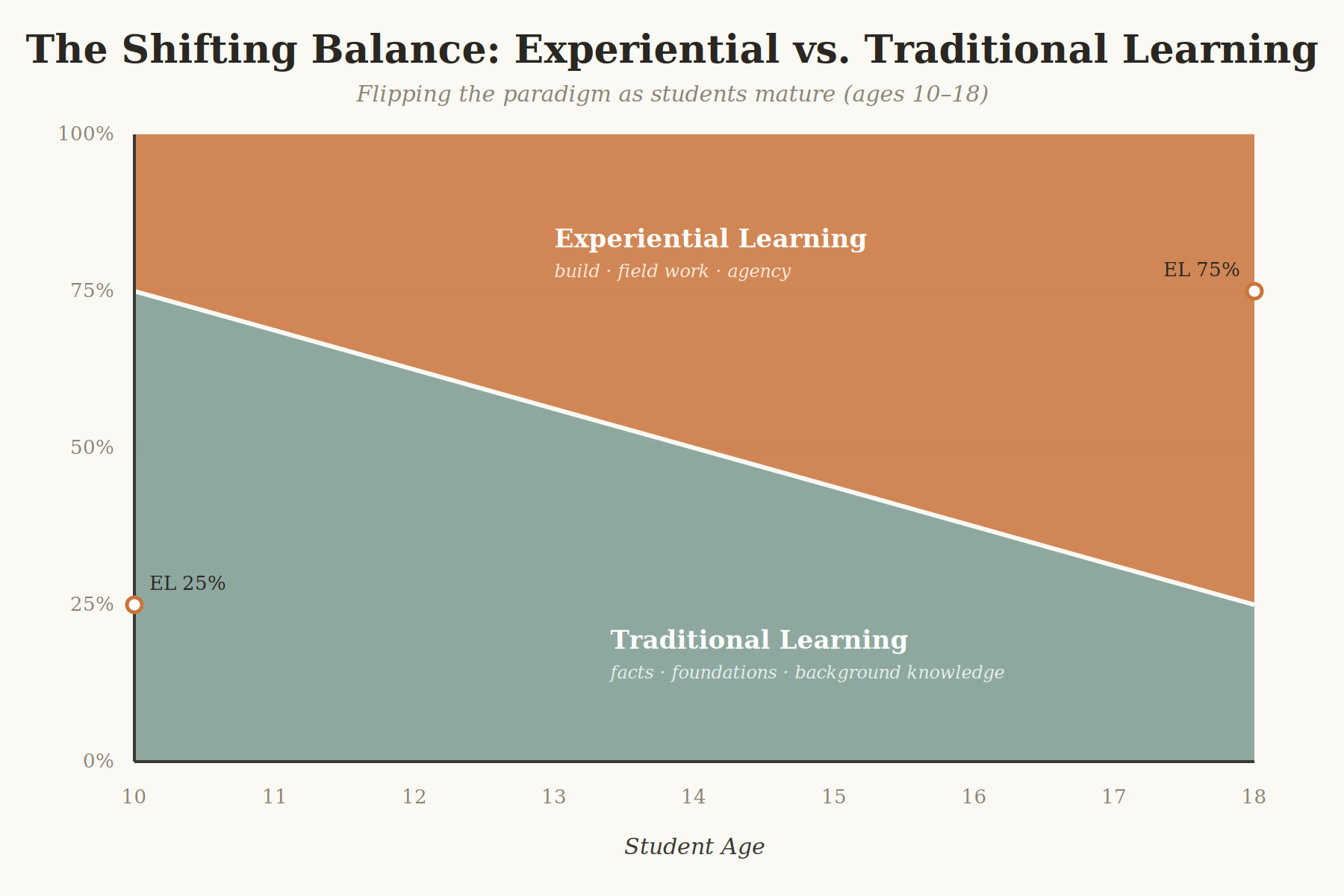
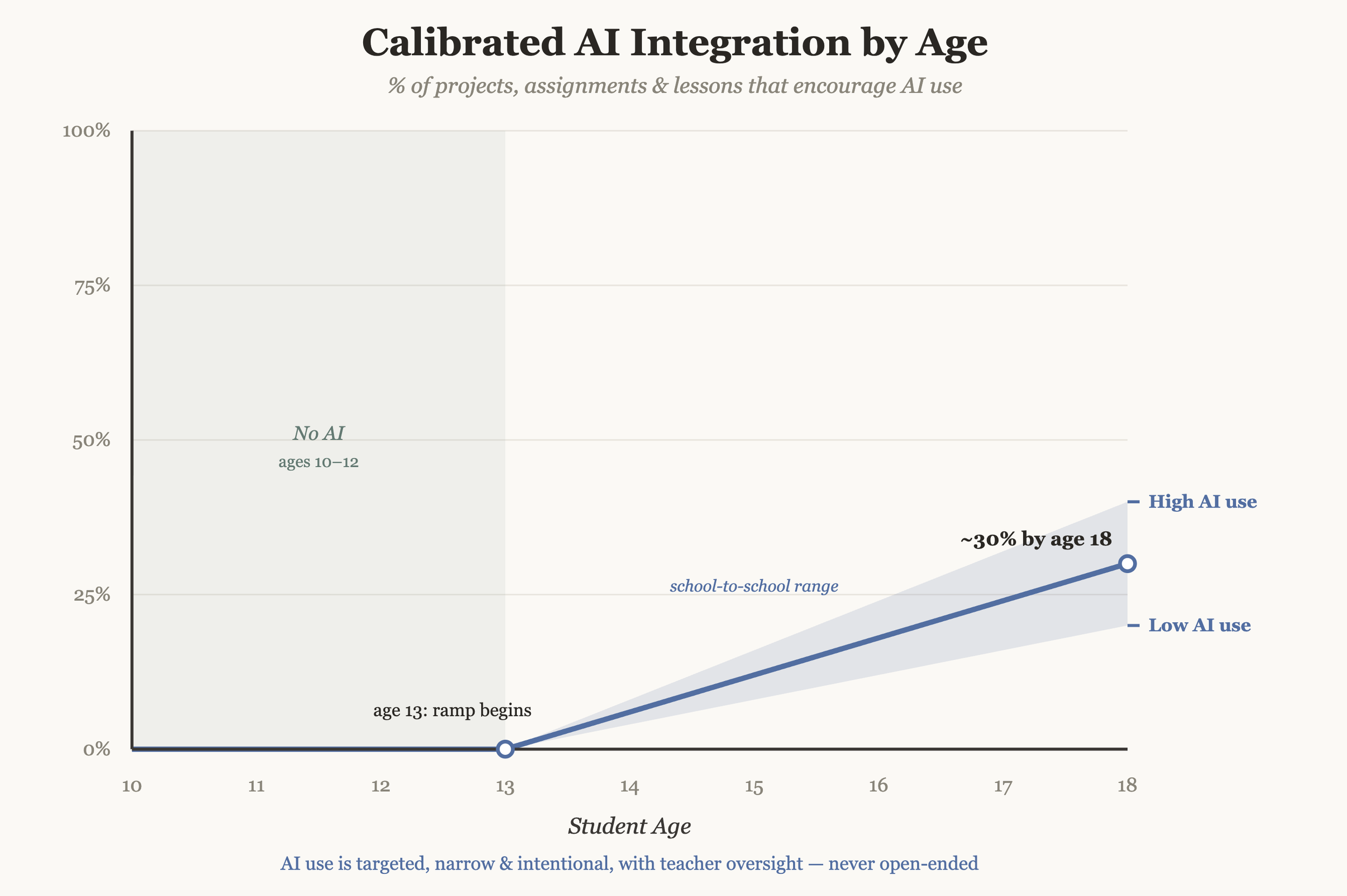
*The numbers in these frameworks are not meant to be exact. A school might reasonably adjust them based on subject, student readiness, and context. What matters is the direction of travel: more foundation-building early, more real-world application later, and more structured AI use as students mature.
Foundations First, Agency by Graduation
The core idea is simple: as students get older, the center of gravity should gradually shift from traditional learning toward experiential learning.
At age 10, I would argue the balance should be roughly 75% traditional learning and 25% experiential learning.
That does not mean younger students should sit silently memorizing facts all day. They still need projects, creativity, movement, collaboration, and play. But the main priority should be building strong foundations.
Students need to learn how to read carefully, write clearly, work confidently with numbers, understand basic scientific concepts, build historical context, develop attention, and practice the habits of learning.
By age 18, the balance should look very different.
At that point, I would like to see something closer to 25% traditional learning and 75% experiential learning. Older students should be building, researching, debating, designing, presenting, testing ideas, working with outside partners, and solving problems that feel connected to the real world.
They should still be learning facts, concepts, and theory. But increasingly, that knowledge should be learned in service of something bigger.
A student working on a climate project still needs science. A student building a business still needs math and communication. A student creating a documentary still needs history, ethics, research, and storytelling.
The difference is that the knowledge now has somewhere to go. It is being developed alongside essential skills like agency, resilience, collaboration, communication, and emotional intelligence.
This is why I do not see traditional and experiential learning as opposites.
The best projects force students to learn facts. The best traditional learning prepares students to do something meaningful with those facts.
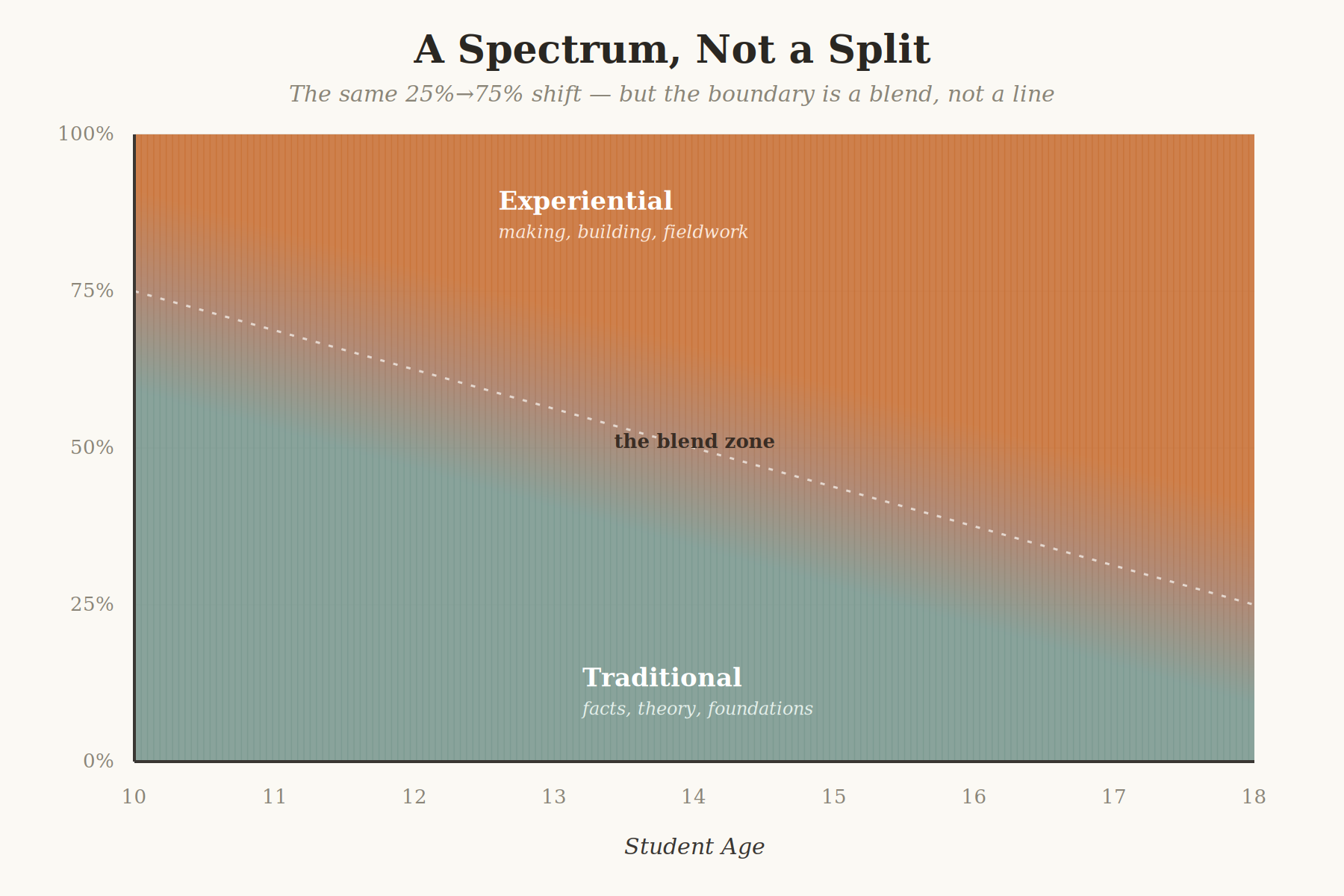
In practice, the boundary between the two should be a blend, not a wall.
Where AI Fits Into the Picture
AI use in schools should follow a similar developmental logic.
When I talk to teachers about AI, one concern is almost always front of mind: students using it as a shortcut.
That concern is valid. If a student can use AI to write the essay, summarize the book, solve the problem, or create the presentation without doing the thinking, then we have a serious problem.
At the same time, most people now recognize that AI skills will matter in the future, and that AI can play a useful role in education.
So again, the key question is timing.
In this framework, I would keep ages 12 and younger as a protected window with no independent AI use.
That does not mean students should never hear about AI. They can learn what it is. They can discuss its strengths, weaknesses, and risks. They can participate in teacher-led demonstrations. Educators can also use AI behind the scenes to improve lessons, generate examples, differentiate materials, or support planning.
But students at this age should not be encouraged to use AI regularly for assignments. They need to build the muscles first.
They need to write the sentence themselves. They need to struggle through the math problem. They need to retrieve information from memory. They need to organize their own ideas. They need to experience the productive frustration that comes with learning.
Around age 13, the ramp can begin.
AI can start to appear in targeted, narrow, teacher-guided ways. It should not begin as open-ended chatbot use, and it should not be framed as “use AI to complete this assignment.” Instead, students should learn to use AI for specific purposes, with clear boundaries.
For example, students might use AI to:
Generate practice questions before a quiz.
Receive feedback on the clarity of a paragraph.
Compare two possible arguments.
Role-play a historical figure after they have already studied the period.
By age 18, I think around 30% of projects, assignments, and lessons could intentionally include AI use.
Some schools might land closer to 20%. Others might land closer to 40%. That range seems reasonable. The exact number matters less than the shape of the curve.
The important thing is that AI use rises slowly and intentionally. AI should enter the learning process only when students are ready to question it, guide it, and remain responsible for the thinking themselves.
There is also real synergy between AI and experiential learning. Used well, AI can help students prototype faster, test ideas, receive feedback, analyze information, and build solutions at a scale that would have been difficult to imagine even a few years ago.
Why This Matters
I have become increasingly tired of the way “balance” gets used in education conversations.
When the debate turns to traditional learning versus experiential learning, the answer is often, “We need balance.” When the conversation turns to AI in the classroom, the answer is again, “We need balance.” (I have definitely been guilty of using that phrase myself many times.)
But too often, the word “balance” hides the real question: balance for whom, at what age, and for what purpose?
Balance for a 10-year-old should not look the same as balance for an 18-year-old. A student who is still building basic reading, writing, numeracy, memory, attention, and background knowledge needs a different learning environment from a student preparing to graduate into university, work, and civic life.
Traditional learning matters deeply in the earlier years because students need knowledge before they can use knowledge well. They need facts and frameworks in their heads. They need vocabulary to express their ideas. They need enough background understanding to recognize whether an argument is strong, weak, original, misleading, or simply wrong.
But as students get older, the risk begins to shift.
The danger is no longer only that they lack foundational knowledge. The danger is that they have knowledge, but have never practiced doing anything meaningful with it.
That is where experiential learning becomes increasingly important. Older students need opportunities to build, create, research, present, test ideas, work with others, and solve problems that feel connected to the real world. They need to move from learning about the world to acting in it.
AI makes this shift even more urgent.
Used too early or too casually, AI can weaken the exact foundations schools are trying to build. Used gradually and intentionally, once those foundations are in place, it can become a powerful tool for feedback, exploration, creativity, and real-world problem-solving.
So the next time an educational leader says, “We need balance,” the right follow-up is:
How should that balance change as students mature?
Ultimately, education should evolve with the student. In the early years, schools should protect the foundations. By graduation, they should give students far more room to apply, create, and act in the world.
